London crowds chant ‘Allahu Akbar’ outside Downing Street in ‘anti-Trump protest’ – WATCH

Protest organisers strongly urged the UK Government to stop what they believe is indirect involvement in serious human rights abuses linked to the ongoing conflict. They said Britain should no longer allow American bombers to operate from UK military bases, arguing that even limited support still connects the country to attacks happening overseas. In their view, continuing to give access to these bases makes the UK partly responsible, even if officials say the support is only defensive.
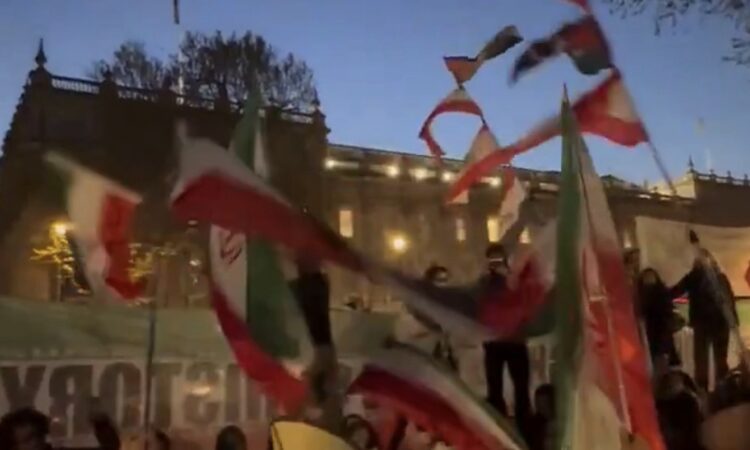
As night fell, large groups of demonstrators gathered outside Downing Street in central London. The protest was arranged quickly in response to rising tensions and was described as an urgent action. It took place on Tuesday evening, April 7, 2026, shortly after Donald Trump made strong and worrying statements about Iran. At that point, people were concerned that the situation could quickly turn into a major war, as the ceasefire announcement had not yet been made.
Footage shared online showed crowds arriving in Westminster, many holding flags and chanting loudly. The atmosphere was intense, with people expressing anger and fear about what they see as growing aggression toward Iran. Some protesters repeatedly shouted “Allahu Akbar,” a common Arabic phrase meaning “God is greatest,” as a way of showing unity and strength during the demonstration. Others carried signs and banners, calling for peace and demanding an end to military actions they believe are unjust.
Before the protest, the Islamic Human Rights Commission, the group behind the event, released a statement with very strong language. They accused Donald Trump of planning actions that could seriously harm the Iranian population. According to them, recent strikes have already damaged civilian infrastructure, and the continued threats, including talk of possible nuclear action, are extremely dangerous. They warned that such moves could lead to massive destruction and loss of life, and they made it clear they would continue to speak out.
The organisers also turned their criticism toward the UK Government. They argued that Britain cannot claim to be neutral while still allowing its military facilities to be used by the United States. Even though officials insist that UK bases are only helping with defensive operations, the protesters said this distinction does not remove responsibility. They believe any form of cooperation in military activity during such a tense period is wrong and should be stopped immediately.
This protest came at a time when the situation in the Middle East was becoming increasingly unstable. Earlier in the day, Donald Trump had warned of possible attacks on important Iranian infrastructure, such as bridges, power stations, and other key systems. These warnings caused fear that the conflict could spread quickly and involve more countries. However, later developments brought a small sense of relief, as the US, Iran, and Israel agreed to a temporary two-week ceasefire. This pause is seen as fragile, and many people remain worried about what could happen next. Talks are still expected to continue, with possible negotiations taking place in Islamabad.
The Islamic Human Rights Commission, which is based in London, has a long history of supporting causes linked to Iran. In the past, members of the group have openly praised Iranian leadership and defended its policies. They previously spoke highly of Ayatollah Ali Khamenei, who died earlier this year, describing him as someone who stood against oppression. Because of these views, critics often question the organisation’s neutrality.
Some opponents claim the group acts more like a supporter of the Iranian government rather than an independent human rights body. They argue that its messaging often reflects political positions rather than balanced advocacy. Despite these criticisms, the organisation continues to present itself as a voice for justice, especially for Muslims facing discrimination or conflict around the world.
The demonstration outside Downing Street was not an isolated event. It is part of a growing number of protests taking place across London under the message “Hands Off Iran.” These protests show that people in the UK have very different opinions about the role of Western countries in the Middle East. While some support Iran and oppose Western military involvement, others strongly disagree and have organised counter-protests, particularly near the Iranian embassy, where they criticise the Iranian government and its actions.
Police presence at the Downing Street protest helped keep things under control, and there were no immediate reports of arrests. The crowd eventually dispersed without major incidents, although nearby areas became busier than usual as people left. Public transport stations, especially Westminster Underground, saw a noticeable increase in passengers during that time.