
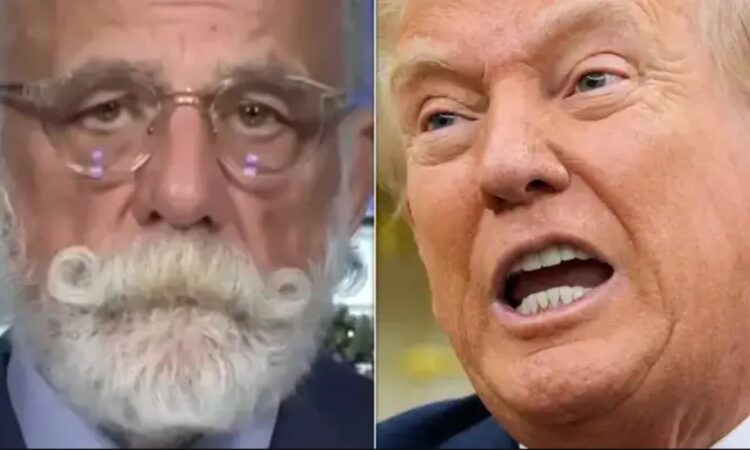
Ty Cobb said there is a real reason for concern that some people around Donald Trump could be taking advantage of what he sees as Trump’s declining mental condition and using that to influence or steer decisions behind the scenes.
Cobb, who worked inside Trump’s White House during his first term, explained that from his perspective, Trump’s mental sharpness and overall behavior have noticeably worsened over time.
Speaking in an interview with Ari Melber, he pointed to several recent incidents as examples of what he sees as erratic and troubling conduct.
These include Trump publicly attacking filmmaker Rob Reiner, going after former special counsel Robert Mueller, and even engaging in a dispute involving the Pope. To Cobb, these actions are not just political disagreements—they reflect behavior he considers increasingly unstable and out of proportion.
He went on to explain that even when he worked with Trump, there were already clear signs of strong ego and impulsiveness. Trump would often push hard for ideas or actions that others in the room felt crossed normal boundaries or could cause serious problems.
However, at that time, there were experienced and influential figures around him people like General John Kelly, General James Mattis, and Nikki Haley who could step in, push back, and persuade him to reconsider. These individuals acted as a kind of buffer or restraint, helping to prevent decisions that might have been reckless or damaging.
According to Cobb, that kind of internal restraint doesn’t really exist anymore. He suggested that the absence of those “guardrails” means Trump may now be more exposed to influence from people who don’t challenge him in the same way, or who may even encourage his more extreme instincts.
That’s where Cobb’s concern deepens he believes it creates an environment where others could potentially guide or manipulate decisions for their own purposes, especially if Trump is more impulsive or less focused than before.
As an example, Cobb suggested that Benjamin Netanyahu may have taken advantage of this dynamic in relation to discussions about Iran, implying that Trump could be more easily influenced on major international decisions than he once was.
Cobb also talked about changes he sees in how Trump communicates. He said Trump’s vocabulary seems more limited than before, with more reliance on simple language, repetition, and increasingly on profanity or aggressive threats.
He described Trump as acting more on impulse, without the same level of control or careful thinking, and suggested this points to a decline in the kind of self-regulation normally associated with clear decision-making.