
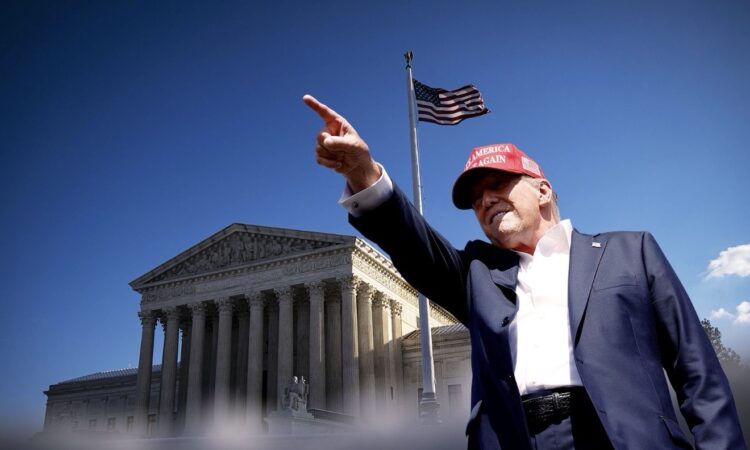
Donald Trump has increasingly shown that he sees the Supreme Court not as an independent branch of government, but as an institution that should support his political agenda. In his view, power and justice appear to be closely tied to his personal authority, a mindset critics say resembles leaders who believe their will stands above constitutional limits.
Tensions escalated after the Supreme Court voted 6–3 on February 20 to strike down several of Trump’s global tariffs, ruling that they were unconstitutional and imposed without proper congressional approval. The decision dealt a major blow to one of the central pillars of his economic policy. Trump responded with fury, publicly attacking the six justices who ruled against him — liberals Sonia Sotomayor, Elena Kagan and Ketanji Brown Jackson, along with conservatives Neil Gorsuch, Amy Coney Barrett and Chief Justice John Roberts.
Trump reserved some of his harshest criticism for Gorsuch and Barrett, both of whom he appointed during his presidency. He called them unpatriotic and accused the court of being influenced by foreign interests and political forces he claimed were working against the country. He later added that their families should feel embarrassed by their actions.
His comments went far beyond normal criticism of judicial decisions. By portraying the justices as traitors or agents of outside influence, he framed the court not as an equal branch of government but as an institution that had betrayed him personally. Such rhetoric raised concerns among legal observers who warned that attacking judges in this way risks undermining public trust in the judiciary and could place justices under increased public hostility.
Trump continued his criticism during his State of the Union address. Speaking directly in front of the justices seated in the chamber, he described the ruling as a disappointing and damaging interference with his economic vision. While the justices sat silently, he promised Americans that he would restore his global tariff program using older federal laws that he believes grant broader presidential authority. However, many legal scholars quickly argued that the new tariffs he introduced afterward — first set at 10 percent and later increased to 15 percent — may also violate constitutional limits.
The situation reflects what legal scholar Ernst Fraenkel once described as a “dual state,” a system in which laws operate differently depending on political loyalty. In such a system, government actions appear normal on the surface, but power is divided between formal legal rules and political authority exercised by leadership. Supporters receive protection, while perceived opponents face punishment or legal pressure.
Trump has often praised the Supreme Court when it delivers decisions that expand presidential power, including rulings suggesting that presidents possess broad authority when acting under official responsibilities. Yet when the court rules against him, it quickly becomes a target of public attacks and accusations of corruption or conspiracy.
Beyond the judiciary, similar confrontations have extended to political opponents, journalists, universities, and government agencies. While many Americans continue daily life with a sense of normalcy, critics point to immigration enforcement actions in which foreign students, green-card holders, and immigrants have reportedly been detained over speech or political activism. Immigration authorities have faced accusations of aggressive enforcement tactics that critics say create fear among both immigrants and American citizens.
Concerns about the politicization of justice intensified when a massive banner displaying Trump’s image and the slogan “Make America Safe Again” was hung outside the Justice Department building in Washington, D.C., promoting the administration’s mass deportation campaign. Similar banners appeared at other federal agencies, symbolizing what critics see as the merging of political branding with government institutions.
In Florida, federal judge Aileen Cannon — appointed by Trump — drew national attention after blocking the release of former special counsel Jack Smith’s investigative report into Trump’s classified documents case. Cannon ruled that Smith had been improperly appointed, permanently preventing the report from becoming public. Critics argued that the decision appeared unusually favorable to Trump, while supporters defended it as a legitimate legal ruling.
Meanwhile, independent journalists Don Lemon and Georgia Fort were arrested during an anti-Immigration and Customs Enforcement protest in Minnesota despite reporting on the event rather than participating in it. Their arrests sparked debate over press freedom and the treatment of journalists covering politically sensitive demonstrations.
During a press conference on election security, Homeland Security Secretary Kristi Noem stated that her role was to ensure that “the right type of people vote” and elect “the right leaders.” The remark drew criticism from opponents who interpreted it as suggesting political loyalty rather than neutral election administration.
Reports also emerged claiming that the Justice Department had withheld or removed documents connected to investigations involving Jeffrey Epstein that referenced Trump. While inclusion in Epstein-related files does not prove wrongdoing, critics argued that suppressing information fuels concerns about unequal treatment under the law.
As these events unfold, confidence in American institutions has declined. Public trust in the Supreme Court — historically one of the most respected institutions in the country — has fallen sharply. A Pew Research poll from August 2025 showed fewer than half of Americans now hold a favorable view of the court, representing a dramatic drop from just a few years earlier.
The Trump era has placed enormous pressure on democratic institutions at both state and federal levels. Courts have sometimes acted as barriers to executive power, but their authority depends largely on voluntary compliance by the administration. When political leaders challenge or ignore judicial rulings, enforcement becomes uncertain.
Supreme Court Justice Robert H. Jackson once warned that the most dangerous forms of oppression are those carried out under the appearance of justice. His words reflect a broader concern that laws must apply equally to powerful leaders as well as ordinary citizens.
The period has forced Americans to confront fundamental questions about democracy, accountability, transparency, and the rule of law. The survival of democratic institutions, many believe, depends on restoring public trust and reaffirming the principle that government exists to serve the public interest rather than any single political figure.