Donald Trump Demands MAGA Ignore the Constitution and Pledge Allegiance to Him, Then Lets Something Slip on Camera

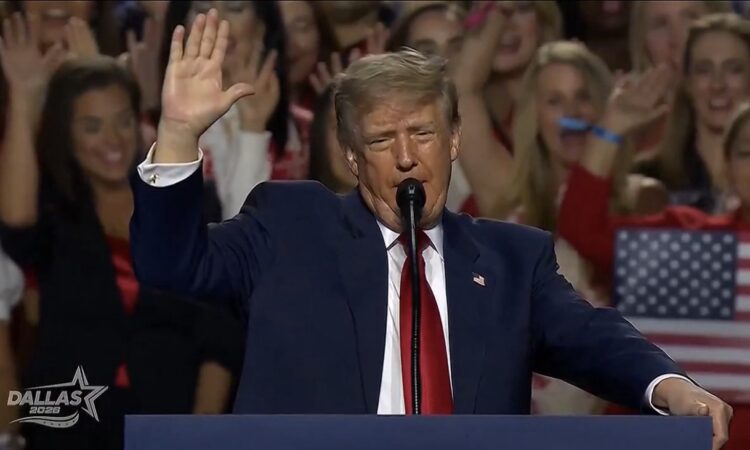
President Donald Trump caused a major reaction during a Republican midterm convention in Texas after asking thousands of supporters to raise their right hands and repeat an unusual pledge with him.
The moment happened during Trump’s speech in Dallas and quickly attracted attention online. In the middle of his remarks, Trump asked members of the crowd to promise that they would go out and vote in the November elections. However, the language he used during the pledge became the main talking point.
Trump told the audience to raise their right hands and repeat after him. As the crowd followed his instructions, he encouraged them to go to the polls with their families and friends.
But the speech took an unexpected turn when Trump said: “I don’t care if I’m registered or not, I’m going to try and cheat like hell like they do.”
He then accused his political opponents of being major cheaters, saying: “There’s never been bigger cheaters.”
The comments immediately caused controversy because Trump has spent years accusing Democrats of election fraud and claiming that the American voting system is not secure. He has repeatedly argued that the 2020 presidential election was stolen from him, although those claims have faced numerous legal challenges and have not been proven.
Because of that history, critics were quick to focus on Trump using the words “cheat like hell,” even though the wider context of his comments included an accusation that his opponents were the ones cheating.
Another part of the speech also attracted criticism. Instead of asking the audience to make the traditional Pledge of Allegiance to the United States, Trump appeared to create his own pledge centred around himself and getting his supporters to vote.
At one point, he described himself as “the greatest president in the history of the United States” while asking the crowd to repeat the pledge. He also made another controversial comment suggesting that supporters who failed to vote could “go to hell.”
The unusual scene quickly spread across social media, where critics described it as strange and disturbing.
California Governor Gavin Newsom, one of Trump’s most outspoken political opponents, accused the president of replacing the traditional Pledge of Allegiance with a pledge to himself.
Newsom argued that voters would face a choice in November between supporting America and supporting Trump.
Journalist Brad Polumbo also reacted to the footage, describing the moment as “strange and embarrassing.” Reporter Nikki Barnes went even further, describing the pledge as cult-like.
Other social media users questioned why members of the audience appeared happy to repeat the words and cheer Trump during the speech.
One person suggested that Trump had accidentally said the “cheating” part out loud, while another expressed disbelief at what had happened during the convention.
The controversy comes at an important time for Trump and the Republican Party as they prepare for the November midterm elections.
Republicans are fighting to maintain control of Congress, and the result of the election could have a major effect on Trump’s ability to push through his political agenda during the remaining years of his presidency.
Democrats are hoping to make significant gains, particularly in the House of Representatives. Polling and political forecasts have increased concerns among some Republicans that the party could lose seats if voters turn against Trump and his administration.
Trump has therefore been heavily involved in the political battle surrounding the election. Voting rules, mail-in ballots, voter identification and proof of citizenship have all become major issues.
Trump has continued to argue that stronger election rules are necessary to prevent fraud. His administration and Republican allies have supported measures that they say would improve election security.
Critics, however, argue that some of these proposals could make voting more difficult for eligible American citizens.
Trump has also supported Republican efforts to redraw congressional voting districts in ways that could help the party maintain its narrow majority in the House. Some of those maps have faced legal challenges, and courts have rejected or blocked certain Republican-backed plans.
Another major legal battle involves Trump’s attempt to introduce changes affecting mail-in voting.
A federal judge blocked parts of an executive order connected to mail ballots, and an appeals court later allowed that block to remain in place. The dispute has become especially important as some states begin preparing and sending ballots for the midterm election.
The legal fight involves questions about how much power the federal government has over elections. Under the U.S. Constitution, states have significant responsibility for running elections, although Congress also has constitutional authority to regulate aspects of federal elections.
Trump has also pushed for the SAVE America Act, legislation backed by Republicans that would introduce tougher voting requirements.
Supporters say the measure would protect elections by requiring people to prove their U.S. citizenship when registering to vote and by strengthening voter identification requirements.
Opponents argue that the changes could create additional barriers for legitimate voters, particularly people who may have difficulty quickly producing the required documents.
The House has passed its version of the legislation, but it has faced difficulties in the Senate because of opposition from Democrats as well as concerns from some Republicans.
All of this means Trump’s controversial remarks in Dallas have come at a particularly sensitive moment.
With the November elections approaching and control of Congress at stake, every statement about voting and election integrity is likely to receive intense attention.
Trump: “Please right your right hand. I pledge to the greatest president in the history of the United States. That loves us so much he can’t even breath. That I will go out with my family, my friends, I’ll do it any way — I don’t care if I’m registered or not, I’m going to try… pic.twitter.com/ywiYe8ZIdu— Aaron Rupar (@atrupar) September 11, 2026
For Trump’s critics, telling supporters to “cheat like hell” was especially troubling because of his long history of accusing other people of election cheating.
His supporters may view the remarks differently, particularly because Trump framed the comment around his claim that his political opponents cheat.
Either way, the unusual pledge has become another controversial moment in an already heated midterm election campaign, with Trump’s words now being widely discussed as Republicans and Democrats prepare for a major political battle in November.