New Trick Some Asylum Seekers Are Using to Delay Interviews and Avoid Deportation Exposed


Some asylum seekers in the UK are reportedly buying sick notes online to avoid attending interviews with the Home Office about their asylum applications.
According to an investigation by the Daily Mail, some applicants are allegedly using these medical certificates to delay their asylum interviews for several months. This gives them more time to prepare their claims, gather evidence and, in some cases, continue working in the UK.
An internal Home Office document obtained by the newspaper raised concerns after officials noticed that similar medical certificates were appearing in different asylum application files.
The document reportedly revealed that some of these sick notes were being purchased for £44 from a website called Home2Lab.
The website allows customers to request medical certificates online without attending a traditional GP appointment. Applicants provide details about their illness, and in some cases, their requests can be approved on the same day.
Home Office staff have reportedly been instructed to flag suspicious medical certificates found in asylum applications.
A Home Office source told the Daily Mail that some asylum seekers are using these sick notes as a way to gain more time before facing questions about their applications.
According to the source, some applicants submit medical certificates just one day before their scheduled interview or even on the day they are supposed to attend.
When this happens, their interviews may be postponed, sometimes for several months.
The source claimed that some applicants take advantage of these delays to strengthen their asylum cases or prepare answers to questions they might face during their interviews.
There are also allegations that some people whose UK work visas are close to expiring apply for asylum to remain in the country.
The insider claimed that delaying an asylum interview could allow certain applicants to continue working while their cases are being considered, although whether someone can legally work depends on their immigration status and the conditions attached to it.
Another concern raised in the report involves asylum seekers who have linked applications, particularly family members or couples.
According to the source, people whose applications are connected are sometimes scheduled to attend their interviews on the same day.
This arrangement is intended to allow officials to question each person separately without giving them an opportunity to compare answers beforehand.
However, the source alleged that one person might submit a sick note to avoid attending while the other goes ahead with the interview.
The person who attends could then share information about the questions asked, allowing the other applicant to prepare before their rescheduled interview.
The insider suggested that this could be particularly important in cases where officials are trying to establish whether a claimed relationship is genuine.
The Home Office was asked through a Freedom of Information request to reveal how many asylum interviews had been postponed because applicants submitted sick notes.
However, the department declined to provide the requested figures.
As a result, the exact number of asylum seekers using medical certificates to delay interviews remains unknown.
The Home Office source claimed that the practice was common, with some applicants allegedly submitting sick notes two or three times before eventually attending their interviews.
The source gave examples of people who had reportedly delayed their interviews because of medical complaints.
One asylum seeker was said to have postponed an interview because of stomach pain, while another allegedly delayed her interview for six months after reporting a burnt foot.
However, there is no suggestion that these particular cases involved certificates issued by Home2Lab.
To investigate how easily medical certificates could be obtained online, the Daily Mail carried out its own test using the Home2Lab website.
A reporter submitted identification documents, completed an online medical assessment and recorded a short video lasting around 30 seconds.
In the video, the reporter falsely claimed to be suffering from flu symptoms.
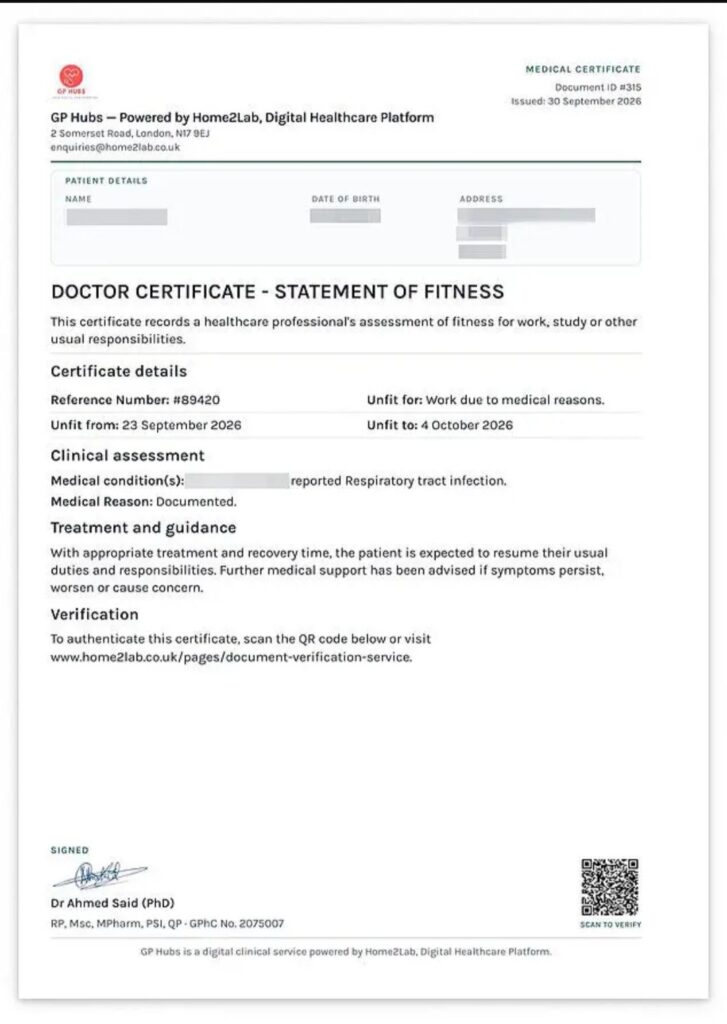
Less than 24 hours later, the reporter received a medical certificate diagnosing a respiratory tract infection.
The certificate was signed by Dr Ahmed Said, who was described as a registered pharmacist rather than a registered GP.
This raised questions because Home2Lab had advertised on its website that its medical letters were approved by UK-registered GPs.
When questioned, the company explained that other qualified healthcare professionals, including pharmacists, could also issue certain medical certificates.
Home2Lab acknowledged that the information on its website had been inaccurate and said it had corrected the wording.
The newspaper also carried out another test involving a reporter who requested a medical certificate for stress and anxiety.
However, the company did not automatically approve that request.
Instead, Home2Lab advised the reporter to arrange a face-to-face appointment with a GP.
The company said this demonstrated that its assessment process included proper checks and that medical certificates were not simply issued to everyone who applied.
Home2Lab strongly denied knowingly providing medical certificates to help people delay immigration proceedings.
A company spokesperson explained that its services were not intended for Home Office or immigration purposes.
The company said its website clearly informed customers that medical certificates should not be requested for such reasons.
It also revealed that it had identified three certificates that were later submitted to the Home Office.
According to the company, all three customers had originally stated that they needed the certificates for employment purposes.
They had provided employer information and submitted medical assessment videos that appeared consistent with their stated reasons.
Home2Lab said none of those customers had disclosed that they intended to use the certificates for immigration matters when making their applications.
The company maintained that it had not knowingly assisted anyone in avoiding an asylum interview.
The investigation has raised wider questions about how the Home Office checks medical evidence submitted by asylum seekers and whether the system could be exploited to delay immigration decisions.
Medical evidence can be important when someone is genuinely too unwell to attend an interview. However, concerns have been raised about whether some applicants are using the process for reasons unrelated to genuine health problems.
A Home Office spokesperson responded by saying that asylum interviews are not postponed simply because an applicant claims to be ill.
The department said sufficient medical evidence from a qualified healthcare professional is required before an interview can be delayed.
The allegations have brought renewed attention to the challenges facing Britain’s asylum system, particularly the need to process applications fairly while preventing possible misuse of immigration procedures.
Although the investigation identified concerns about online sick notes, the full scale of the alleged practice remains unclear, and there is no evidence that asylum seekers generally are using false medical certificates.
The issue now raises questions about whether further checks are needed to ensure that genuine medical cases are treated fairly while preventing deliberate attempts to delay asylum interviews.