Mathematician’s ‘Doomsday’ prediction gave an exact date for the end of the world – and it’s just weeks away

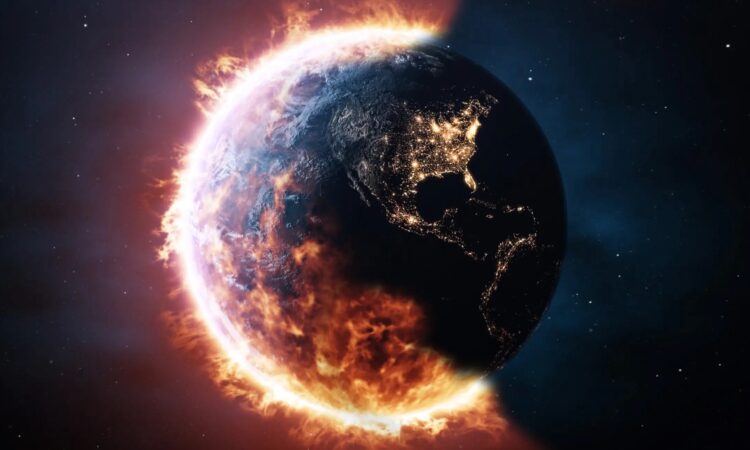
A prediction made by a mathematician more than six decades ago has suddenly started attracting attention again, with people online looking back at a warning that appeared to put a date on a possible disaster for humanity.
The prediction was made in 1960 by mathematician Heinz von Foerster and his colleagues. Their research looked closely at the rapid growth of the world’s population and what could happen if that growth continued at the same speed for many years.
At the time, the world’s population was growing quickly. Von Foerster and his team used mathematical calculations to study the trend and tried to work out where it could eventually lead.
Their conclusion was extremely alarming.
According to their model, if human population growth continued without slowing down, humanity could eventually reach a point where the Earth would no longer be able to cope with the number of people living on it.
The date their calculation pointed towards was November 13, 2026.
Interestingly, that date falls on a Friday, meaning it is also a Friday the 13th. With the date now getting closer, the old prediction has resurfaced on social media, with some people questioning whether the mathematician could have somehow seen a major crisis coming.
However, there is a very important difference between a mathematical prediction based on old population trends and a scientific prediction that the world will actually end.
Von Foerster’s calculation was based on the assumption that population growth would continue in a particular way. But population growth did not continue along exactly the same path.
When the research was published in 1960, there were roughly 3 billion people on Earth. Today, the global population is around 8.3 billion.
That huge increase may sound like the prediction is coming true, but the rate at which the population is growing has changed considerably.
Birth rates have fallen in many countries around the world. People are also having smaller families than previous generations in many parts of Europe, Asia and other regions.
There are several reasons for this change. Better access to education, greater access to healthcare, family planning, higher living costs and changing attitudes towards having children have all played a role.
As a result, population experts do not expect the world’s population to keep increasing forever at the same rate.
This is one of the biggest problems with using the 1960 prediction to claim that the world will end in 2026.
The mathematical model was based on information and trends available at the time. It could not account for all the social, economic and technological changes that would take place over the following six decades.
Von Foerster’s work was nevertheless important because it highlighted a genuine problem.
The Earth has limited resources, while human beings continue to need food, water, energy, land and other resources to survive.
If population growth were to continue rising rapidly while resources remained limited, it could place enormous pressure on the planet.
That pressure could contribute to problems such as food shortages, environmental destruction, climate change, water shortages and competition over natural resources.
In the original research, the researchers used dramatic language to describe what could happen if population growth continued unchecked. Their calculations suggested humanity could eventually “squeeze itself to death.”
But this should not be understood as a prediction that millions or billions of people will suddenly die on November 13, 2026.
There is no scientific evidence showing that the date will bring an apocalypse or that the world will suddenly become uninhabitable.
Instead, the research is now more useful as a warning about the importance of managing population growth and the planet’s resources carefully.
The prediction has become particularly interesting online because the date is now less than three months away.
Social media has a history of bringing old doomsday predictions back into the spotlight when the dates involved get close.
People have made claims about the end of the world for centuries, often using religion, ancient calendars, astronomy or mathematical calculations to support their ideas.
One of the most famous examples in recent history involved December 21, 2012.
That date became famous because it marked the end of a major cycle in the ancient Maya Long Count calendar.
Some people claimed the date represented the end of the world. Others predicted a massive solar event, a mysterious planet crashing into Earth or another disaster that would wipe out humanity.
The claims spread around the world and created enormous interest.
But Maya scholars explained that there was no evidence that the ancient calendar predicted an apocalypse.
The date simply represented the end of one calendar cycle and the beginning of another.
When December 21, 2012 finally arrived, there was no global catastrophe.
Life continued as normal, and the world moved into another calendar cycle.
There have also been other attempts to use mathematics and probability to estimate humanity’s future.
In 1983, astrophysicist Brandon Carter introduced what became known as the Doomsday Argument, sometimes referred to as the Carter Catastrophe.
The idea is based on a simple but controversial assumption about where an individual is likely to exist within the entire history of humanity.
In very simple terms, the argument suggests that if the total number of humans who will ever live is limited, then there is no particular reason to believe that we happen to be living extremely early or extremely late in human history.
From that assumption, the theory attempts to estimate how many people might live after us.
However, it does not provide a reliable date for when humanity will end, and it has been debated by scientists and philosophers for decades.
The same caution applies to the 1960 population prediction.
The fact that a mathematical model produces a specific date does not automatically mean that the event will happen on that date.
Mathematical models depend heavily on the assumptions and information used to create them.
If those assumptions change, the outcome can also change.
That appears to be particularly important in this case because global population growth has slowed considerably since the 1960s.
Although there are now far more people on Earth than there were when von Foerster made his calculation, the growth rate is not behaving exactly as his model assumed.
Some countries are now experiencing population decline because birth rates have fallen below the level needed to maintain their populations without immigration.
Other countries are still experiencing rapid population growth, but even there, demographic trends can change over time as education, healthcare and economic conditions improve.
This means the world of 2026 is very different from the world von Foerster was studying in 1960.
There is therefore no reason to believe that humanity is going to suddenly reach a mathematical breaking point simply because the calendar has reached the date mentioned in an old research paper.
That does not mean the concerns behind the research should be ignored.
The world still faces serious environmental challenges.
Climate change, rising demand for resources, pressure on food supplies, water shortages, pollution and the destruction of natural habitats are all genuine issues.
The question of how many people the planet can sustainably support is also still discussed by scientists, economists and environmental experts.
Technology and better management of resources can also change what the planet is capable of supporting. Improvements in agriculture, renewable energy, healthcare and food production have already changed the way billions of people live.
So, while the 2026 date may sound frightening, the prediction should not be treated as a countdown clock.
There is no credible scientific evidence that the Earth will come to an end on Friday, November 13, 2026.
Instead, the old calculation can be viewed as a warning about what might happen when population growth, resource use and environmental pressures are allowed to grow without proper planning.
The prediction may have been made more than 60 years ago, but the questions behind it remain relevant.
Humanity has continued to grow, the planet’s resources remain limited, and governments around the world still have to find ways to provide food, water, energy and housing for billions of people while protecting the environment.
So while social media users may be counting down to the date and wondering whether the old prediction could finally come true, experts have little reason to believe that November 13 will bring the end of the world.
The most likely outcome is far less dramatic.
The date will arrive, Friday the 13th will pass, and humanity will continue.
What von Foerster’s work really reminds us of is not that the world has a fixed date for its destruction, but that the choices humans make about population, resources and the environment can have consequences for generations to come.