
In early May 2024, police stopped what they believe could have been one of the deadliest terror attacks ever planned in the UK. A man named Walid Saadaoui was standing beside his Peugeot in a hotel car park in Bolton, waiting to receive what he thought was a large shipment of deadly weapons. He believed the delivery included assault rifles, pistols, and hundreds of rounds of ammunition. What he did not know was that the entire operation was being closely watched by armed police.
Saadaoui’s plan was simple and horrifying. He wanted to kill as many Jewish people as possible in an attack inspired by the so-called Islamic State. Police say the intention was mass murder. Officers later explained that the scale of violence being planned was comparable to the recent Bondi beach shooting in Australia, where gunmen attacked a Jewish event and left many people dead.
According to investigators, Saadaoui and his group planned to start by opening fire on a large public gathering in Manchester city centre, possibly a pro-Israel march. After that, they intended to move on to Jewish schools and synagogues in north Manchester, an area where much of the city’s Jewish community lives.
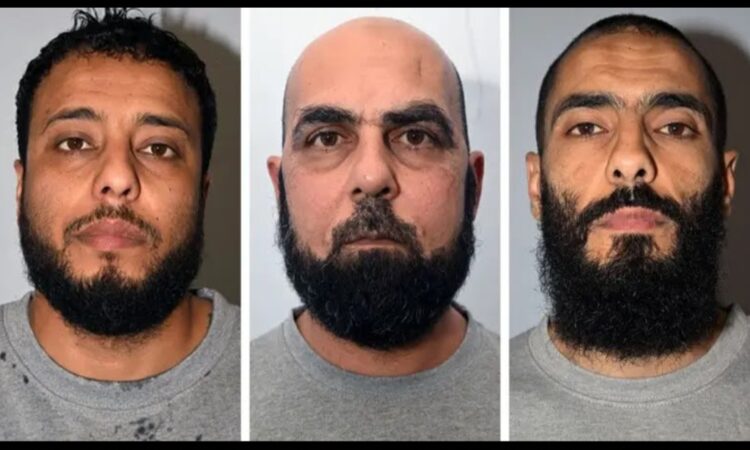
Just as Saadaoui waited for the weapons to arrive, armed officers moved in. They tackled him to the ground as he tried to run and arrested him on the spot. At the same time, police arrested his co-plotter, Amar Hussein, at a furniture business in Bolton where he worked and slept. Saadaoui’s brother, Bilel, was also arrested at a gym in Wigan after police discovered he knew about the plot but failed to report it.
Senior police officers later said this was one of the most serious counter-terrorism investigations Britain has seen in years, involving officers and resources from across the country.
All three men have now been found guilty at Preston Crown Court. Saadaoui and Hussein were convicted of preparing acts of terrorism, while Bilel Saadaoui was convicted of failing to disclose information about a terrorist plot. They are now facing long prison sentences.
Police leaders have described the plot as deeply disturbing. The Chief Constable of Greater Manchester Police said the plans were “genuinely chilling” and made clear that the intention was mass murder, not talk or exaggeration. Another senior counter-terrorism officer said there was no doubt police had stopped what could have been the deadliest terror attack in UK history.
The investigation began quietly in late 2023, when officers discovered multiple Facebook accounts filled with antisemitic messages and praise for Isis. All of the accounts were linked back to Saadaoui, a Tunisian-born former restaurant owner living in Wigan. He had no criminal record and, on the surface, appeared to be an ordinary man.
At first, police could have charged him with a lower-level terror offence related to online activity, which would likely have led to a short prison sentence. Instead, they chose to dig deeper to find out whether he was just an online extremist or a real and immediate danger.
Saadaoui had moved to the UK in 2012 after marrying a British woman, which later gave him citizenship. He worked at a holiday park and eventually saved enough money to open an Italian restaurant in Norfolk. In 2023, his life changed again when he left his first wife, remarried, and moved to Wigan to be closer to his brother.
To uncover the truth, police used an undercover officer posing as a fellow extremist. Over several months, the officer gained Saadaoui’s trust and became one of his closest confidants. At one point, when asked what might happen if police stopped watching Saadaoui, the undercover officer replied bluntly that many people would be killed.
Through this contact, police were also introduced to Amar Hussein, a man Saadaoui knew from his mosque who shared the same extreme views. The group began meeting in person and openly discussed carrying out a terrorist attack.
In March 2024, the men travelled together to Dover, talking openly about being part of a terrorist gang and discussing previous mass killings. The following day, Saadaoui drove them around north Manchester, stopping to photograph Jewish schools and synagogues as possible targets.
Police constantly feared the situation could spiral out of control, either because the undercover officer might be exposed or because the men might carry out a simpler, sudden attack. Despite these risks, officers decided to continue the operation, believing they could manage the danger and stop the plot at the right moment.
As the months went on, Saadaoui’s behaviour became more alarming. He spoke about infiltrating Jewish social media groups to track public events. He set a rough timeline for the attack in summer 2024. Police noticed signs that suggested he was preparing for death. He trimmed his beard, wrote a will, gave instructions to his brother, spoke about visiting his mother one last time, and made sure his wife could drive independently.
Investigators also discovered that Saadaoui had access to a large amount of cash. He had sold his restaurant for around £90,000 and never put the money into a bank. Most of it was later found hidden in a safe buried in his garden.
On 8 May, the final step of the plan was supposed to happen. The undercover officer was to deliver the weapons, which were real firearms but unable to fire live ammunition. If the delivery failed, Saadaoui had instructed that security officers should be killed and the attack launched anyway.
Police later described this stage as letting the suspects get as close as possible to carrying out a real terror attack without allowing anyone to be harmed. When Saadaoui was arrested, he still believed the undercover officer was his friend and initially claimed the situation was a misunderstanding involving mobile phones. He was stunned to learn the truth.
At trial, he tried to argue that he had been pressured by Isis figures abroad and never truly intended to attack. Prosecutors rejected this completely, and the jury agreed.
The details of the plot have deeply shaken the Jewish community in Manchester, especially as it targeted the same general area as a previous deadly synagogue attack. Police leaders have acknowledged the fear this causes and said no community should have to live under such threat.
Community security groups say the case has left many Jewish people frightened and exhausted by the level of antisemitism in the UK, with some choosing to leave the country altogether. Counter-terrorism officers admit that antisemitic terror plots now make up a significant part of their workload and say they are fully aware of the fear Jewish communities continue to live with.
Police insist that stopping this attack shows how seriously the threat is being taken, but the case has also made clear just how close the country came to an unimaginable tragedy.